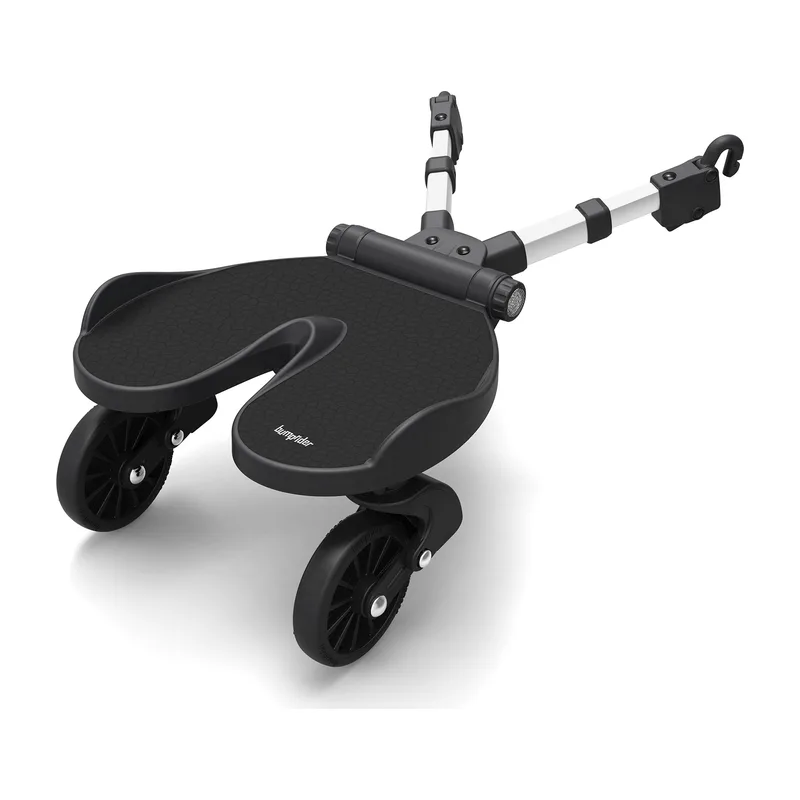
In depth: buggy boards explained
What the parent tester reports actually tell you, and what they cannot
The most detailed independent evidence for buggy boards in the UK comes from the Mother&Baby Awards, where parents use products with their own children and report back. For the Bumprider Ride-On Board, seven named testers contributed in 2016 and 2017. They praised the quick attachment, the fit across several travel systems, the lightness and the handling over kerbs. They criticised the distance the board sticks out, contact with shins on cheaper pushchairs, a narrow wheel spacing for some strides, connectors that could slip or mark shiny frames, and the limited choice of colours.
The ride comments are the most specific part of the Bumprider reports. One tester said her toddler stayed on over bumpy pavements and potholed roads, and another found it smoother than other boards she had used. Only one tester commented on the suspension itself, and she reported no problems, so the sprung platform is supported by a single first-hand remark rather than a comparison. Mother&Baby's own verdict called the board quite expensive at its recommended price of £69.99 at the time, which is close to what Bumprider charges today.
For Lascal, Mother&Baby published comments from seven testers on a BuggyBoard, without stating which size. They liked the universal fit, the compact storage and the brand's reputation, and disliked unclear assembly instructions, a bumpy ride and the board catching on some pushchairs. A separate note records that a parent tester used the Lascal Maxi for the 2021 awards, where it was shortlisted.
None of this is a lab measurement. There is no published figure for vibration, rolling resistance or connector strength for any board here. The reports are useful for spotting recurring problems, such as shin contact, but they cannot rank two boards that were never assessed side by side, which is why we weigh them alongside review volume and specifications.
Lascal Mini against Bumprider Ride-On Board: evidence against engineering
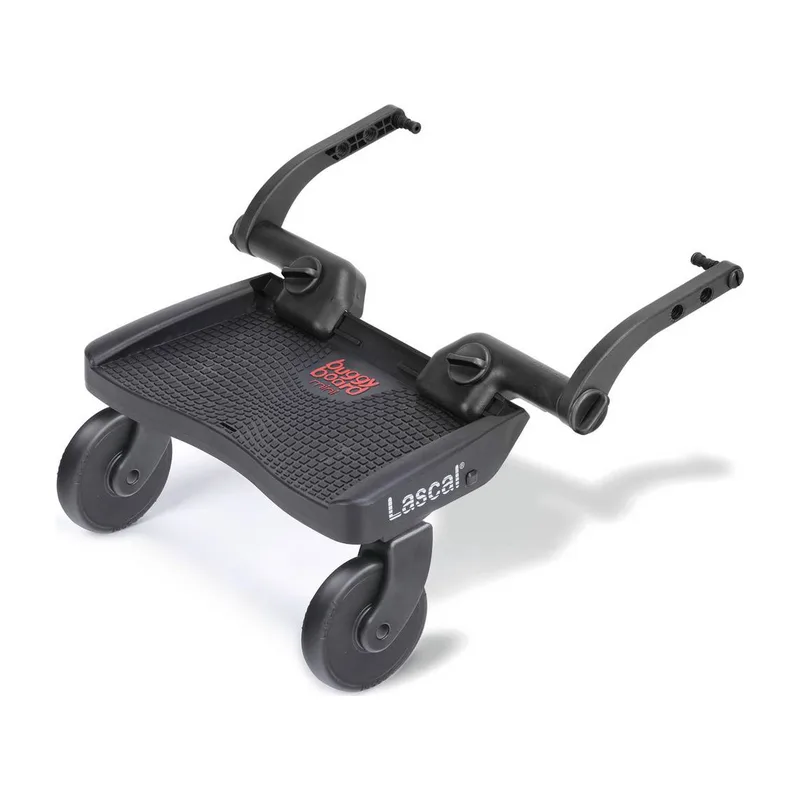
These two boards finish close together, and the reason is instructive. On specifications, the Bumprider has the stronger case: it lists suspension, an adjustable platform length and quick-release connectors that stay on the frame. On evidence, the Lascal Mini is far ahead, with 109 verified reviews at Argos against parent reports for the Bumprider that are close to ten years old.
The Mini's lead on evidence is also lopsided in a useful way. Of the 109 reviews at Argos on 14 November 2026, 79 give five stars and 19 give four, so 98 of 109 owners rate the Mini at four or five. Six give three stars, two give two and three give one. Argos also breaks the score down into design (4.5 out of 5) and quality (4.6 out of 5), and 90 per cent of reviewers say they would recommend the board. That spread is why the Mini scores highest on customer feedback here: it is not one glowing average but a large group of owners with very few unhappy ones.
The praise is practical rather than emotional. Owners mention quick assembly, a board that clips on and off without fuss, a solid build and a platform that stays out of the way while walking. Several name the pushchair they use it with, including a Silver Cross Wave, a Nuna and a lightweight travel buggy, which is more useful to a buyer than any compatibility claim because it comes from people who actually fitted it.
The complaints cluster around the first fitting. Argos's own summary of the reviews notes that some owners found the instructions unclear and fitting awkward on certain pushchairs, and one reviewer needed a few attempts before it sat properly. That matches the unclear assembly instructions that Mother&Baby's parent testers mentioned for a Lascal board, so it is a pattern rather than a one-off. None of the reviews visible on the page mention the board knocking the parent's shins, the complaint Mother&Baby's testers raised most often about the Bumprider.
Price tips the balance. The Mini costs £9.90 less and carries 2 kg more. For a family on smooth town pavements, those two facts outweigh the suspension. For a family on rough paths, the Bumprider's ride is the feature they would notice every day, and they should treat our ranking as a close call rather than a verdict. The ranking could flip if a UK retailer starts collecting reviews of the Bumprider: on our feedback criterion, ten or more recent verified reviews with a similar spread to the Mini's would be worth more than the parent reports from 2016 and 2017 that it relies on now.
One practical point favours Bumprider: the company sells connectors, wheels and a locking screw individually, all listed in stock on the assessment date. Lascal's website showed only a holding page when we checked, so spare parts for Lascal boards may be harder to source over time. Argos lists a two-year manufacturer's guarantee on the Mini, which covers the first stretch of use whatever happens to Lascal's own site; Bumprider's page for the Ride-On Board does not state a guarantee period.
Looking after a board so it lasts through two children
Buggy boards spend their lives at ankle height, so grit in the wheels and connectors is the main wear point. Bumprider sells replacement wheels and individual connectors, which suggests these are the parts that wear first. Wiping the connectors and checking that they clamp firmly before each outing costs little time and avoids the slipping that Mother&Baby testers reported on shiny frames.
When the board is not in use, both Bumprider and Lascal let you hook it up behind the pushchair rather than removing it. That keeps the connectors in place but adds weight to the frame, so take it off for car journeys where boot space is tight.
If you buy second hand, check the platform for cracks around the wheel mounts and ask whether both connectors are included. Bumprider sells a single replacement connector and a full connector kit separately on its site, so a missing part is fixable for that brand. For Lascal boards, ask the seller to include the connectors and fitting screws, because we could not find Lascal spares on sale from the manufacturer.
When a board is the wrong answer and a double pushchair is the right one
A board works best when the older child walks most of the way and rides for the last stretch. If your older child needs to ride for most of each outing, or is under two, a board asks a lot of their balance and grip. Every board here is listed from two years at the earliest, which reflects that.
Cost is closer than it looks. The seated boards in this comparison cost between £89.90 and £135, and they add load to a single pushchair that was not designed for two children. A tandem or convertible pushchair costs more, but carries both children with a proper harness and a reclining seat. For families with a short age gap who walk long distances, that is often the safer long-term buy.
For most families the board is a bridge between those two stages: useful for a year or two, then sold on. That is another reason to favour boards with a broad fitting range and spare parts, because the next owner is unlikely to have the same pushchair as you.
Buying guide: choosing the right buggy board
The gap between your pushchair's uprights decides more than the brand
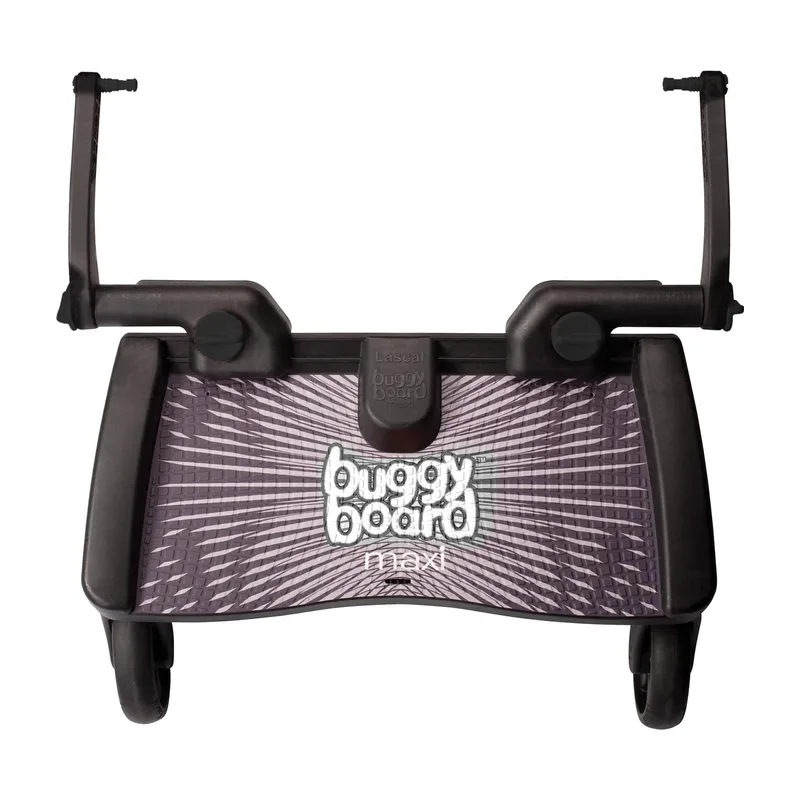
Every universal board in this comparison clips to the two vertical tubes at the back of the pushchair, and the manufacturers express compatibility as a range of distances between those tubes. The Lascal Mini takes 26 to 50 cm, the Lascal Maxi 31 to 54 cm. Measure your own frame at the height where the connectors would sit before you look at anything else, because a board that cannot reach both tubes is useless however good its reviews are.
Brand lists are a rougher guide. Bumprider names Bugaboo, Cybex, Babyzen, UPPAbaby, Nuna, Stokke and Joolz among compatible makes, but a brand has many frames and some change shape between generations.
Where the measurement is tight, the wider range wins. On a pushchair with uprights 52 cm apart, only the Lascal Maxi and Maxi Plus are stated to reach, and the Mini would not be the right buy even at £14.99 less.
A cheap tape measure settles this in a minute, and it is worth doing before reading any review, because a parent who praises a board on one pushchair tells you little about how it fits yours.
Twenty kilos is the real ceiling, whatever the age guidance says
Four of the five boards stop at 20 kg according to the figures we could verify, and the Lascal Mini at 22 kg. The age ranges look more varied, running from two to four years on the Mini to two to six on the Maxi, but a child grows out of a board by weight long before the upper age if they are tall for their age. Weigh your toddler before deciding how much future use you are paying for.
Sources also disagree. Mumsnet quotes 29 kg for the Lascal Maxi while Halfords lists 20 kg. We use the lower figure because exceeding a manufacturer's limit puts strain on the connectors and the pushchair frame. If the extra two kilos matter, the Mini's 22 kg is the only figure above 20 we could confirm at a retailer.
If your child is close to the limit already, a board is likely to be a short-term purchase, and a cheaper model makes more sense than one with a long age range you will never use.
A seat is worth paying for only if your toddler still naps on the move
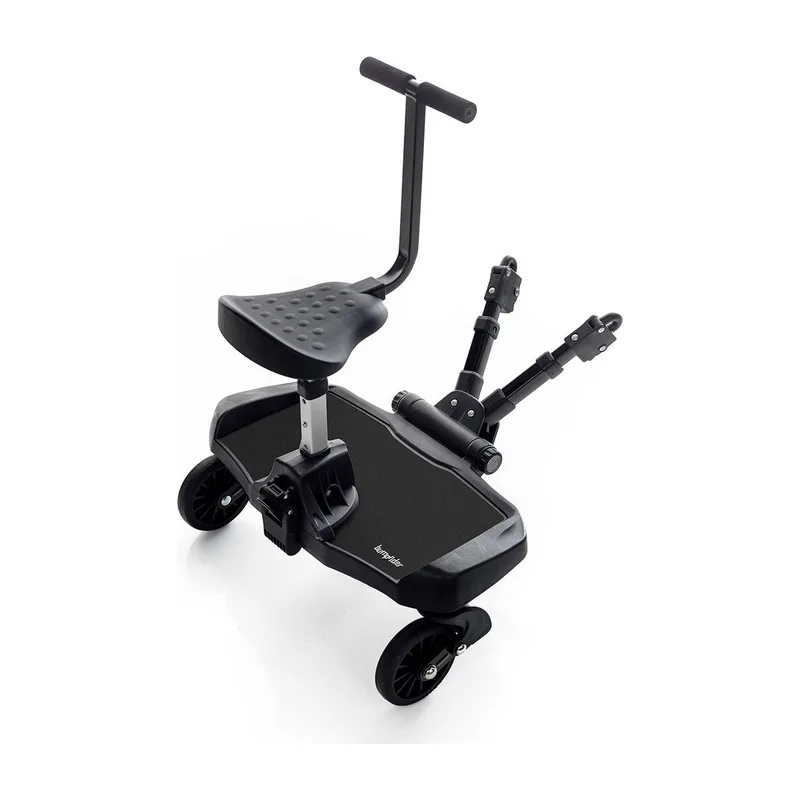
Stand-on boards cost less and weigh less. The Lascal Mini at 1.8 kg and the Bumprider at 1.9 kg are the lightest boards with a stated weight, against 2.3 kg for the Bumprider +Sit. A seat adds weight that you push all day and lift every time you fold the pushchair.
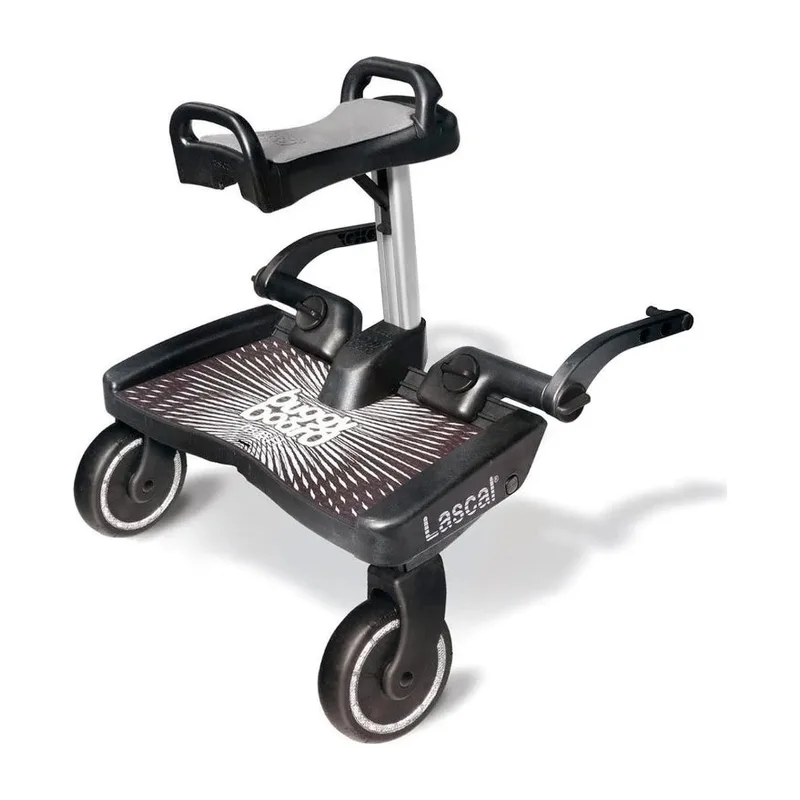
The case for a seat is a child who falls asleep on the way home or cannot stand for long. The Bumprider +Sit is the cheapest board here with one fitted, at £89.90. The Lascal Maxi Plus includes a saddle instead, which supports a child sitting upright but has no backrest, so it helps less with a nap.
There is a middle route. Bumprider's Seat+ and Lascal's saddle can be bought later for the plain boards. That only works if the part is in stock, and the Bumprider Seat+ was not on 14 November 2026, so check before relying on it.
Seat versions also sit higher, which can bring the child's head closer to the handlebar. On compact pushchairs with low handles that is worth checking in a shop before you buy online.
Suspension shows up in parent reports long before it shows up in a spec sheet
Only Bumprider lists suspension for its boards. Mother&Baby's parent testers described the Ride-On Board as smooth over rough ground and kerbs, while a tester of a Lascal board reported a bumpy, noisy ride. Those are individual experiences rather than measurements, but they point the same way as the specifications.
Wheel size and platform height matter too. The Bumprider platform sits 19.5 cm off the ground. A lower platform is easier for a small child to step onto, while a higher one clears kerbs more easily. If your daily route has cobbles or broken paving, give more weight to the ride criterion than we do.
No board here suits off-road walks. If your buggy is an all-terrain model and you spend weekends on forest tracks, a double pushchair or a sling for the younger child may serve better than any board.
Retailer descriptions rarely mention noise, but plastic wheels on paving can be loud. If you walk early in the morning near sleeping neighbours, it is one more reason to favour softer wheels or a sprung platform.
Your stride and your handlebar matter more than most reviews admit
The most common complaint across the parent tester reports is shins and ankles hitting the board. Mother&Baby's testers raised it for the Bumprider on cheaper pushchairs and for a Lascal board, and one noted that it forces a shorter stride. This is about geometry: a board sits between your feet and the back axle, so the shorter the handlebar extension and the longer your legs, the more likely you are to kick it.
Adjustable platform length helps. The Bumprider's platform adjusts from 33 to 57 cm, and the +Sit from 29 to 53 cm, which lets you move the board further back. Lascal does not state an adjustable length for their boards. If you are tall, that adjustability is worth more to you than any other feature in the comparison.
Check your handlebar height too. A pushchair with an extendable handle gives you room, while a fixed low handle on a compact buggy leaves little space for a board and a child standing on it.
Tall parents should try walking with the board fitted at home before the first long outing, and adjust the platform length or connector height before deciding the board does not suit them.
Universal connectors are a promise, and the small print shows where it ends
Every universal board relies on a pair of clamps that wrap around the pushchair's rear uprights, with a strap or arm linking them to the platform. The claim of fitting nearly every pushchair, which Lascal makes for the Maxi, depends on your frame having straight, round tubes at a usable height. Pushchairs with oval, angled or very thick rear legs are where universal connectors struggle, and that is a frame issue the board makers cannot fully solve.
Mother&Baby's parent testers give two concrete warnings. One reported that Bumprider's connectors could slip or mark a shiny metal frame, and another found that a Lascal board did not sit well on a Joie Nitro. Neither is a reason to avoid either brand, but both are reasons to fit the board at home and check it before the first walk to the shops.
A brand-specific board, made by a pushchair maker for its own frames, avoids the problem by design because it attaches to fixed points rather than clamping round the tubes. None is in this comparison, because we could not find one in stock at a UK retailer on the day we checked. The trade is that such a board cannot follow you to a different pushchair, so if you expect to switch to a compact travel buggy for holidays, a universal board is the more flexible choice.
Before ordering, check that the retailer shows stock and a delivery date, because availability for some models changed between shops on the day we checked.
Folding and storage decide whether the board stays on the pushchair
A board that is fiddly to remove tends to stay on, and a board that stays on changes how the pushchair folds. Lascal says its redesigned connectors interfere less with the folding mechanism, and both Lascal and Bumprider let you hook the board up behind the pushchair when it is not in use. Bumprider also sells hanging straps for both of its boards as separate parts.
Size when stored matters for small car boots. The Lascal Mini is 8 cm deep according to Argos and the Maxi 11 cm according to Halfords, while the Bumprider platform is 31 cm wide and the +Sit 46 cm. A Mother&Baby tester found a Lascal board an awkward shape for a boot, so measure the space next to your folded pushchair if you will carry both.
If you mainly need a board for occasional trips, the lightest stand-on boards are the easiest to live with. The Lascal Mini at 1.8 kg and the Bumprider at 1.9 kg weigh less than many changing bags, while the seated Bumprider adds 0.4 kg.
The quickest way to check is to fit the board, fold the pushchair and see whether the clamps catch any hinge. If they do, a board you can unclip in seconds is the better option than one that stays fixed.
The cheapest board is the right buy for most families with one pushchair
For a single everyday pushchair with uprights inside the 26 to 50 cm range, the Lascal Mini at £60 does what most families need and has by far the most customer feedback. It is our top pick for that reason, not because it beats the others on every feature.
Spending more makes sense in three specific cases. Rough pavements argue for the Bumprider's suspension at £69.90. A wide frame or an older child argues for the Lascal Maxi. A toddler who still naps argues for the Bumprider +Sit. The Lascal Maxi Plus is harder to recommend unless you specifically want the saddle bundle.
Prices for the same board vary between retailers. On 14 November 2026 the Lascal Maxi cost £74.99 at Halfords and £90 at Argos, so a quick comparison before buying can save as much as the difference between two models.
Weight differences of a few hundred grams sound trivial but add up when you lift a pushchair, a board and shopping into the boot several times a day.
Frequently asked questions
What is the best buggy board?
In our comparison the Lascal BuggyBoard Mini is the best choice for most families, because it fits uprights 26 to 50 cm apart, takes 22 kg and has 109 reviews at Argos. The Bumprider Ride-On Board is close behind if you want suspension. The ranking combines specifications, parent tester reports and customer reviews.
What age is a buggy board suitable for?
Most boards here are listed from two years. The upper limit ranges from four for the Lascal Mini to six for the Lascal Maxi. In practice the weight limit, usually 20 kg, is reached first by many children. Weigh your child before buying if they are tall for their age.
Will a buggy board fit my pushchair?
Measure the distance between the two rear uprights where the connectors would sit. The Lascal Mini fits 26 to 50 cm and the Lascal Maxi 31 to 54 cm. Brand-specific boards made by pushchair makers fit only that maker's frames. Owners at Argos report the Lascal Mini on a Silver Cross Wave, a Nuna and a lightweight travel buggy, and some found the first fitting fiddly, so try it at home before relying on it.
Is a buggy board with a seat worth it?
It is worth it if your child still naps on the move or tires quickly. The Bumprider Ride-On Board +Sit is the cheapest seated board in our comparison. A seat adds weight, 2.3 kg for the Bumprider +Sit against 1.9 kg for the plain board. Bumprider's Seat+ for the plain board is an alternative once it is back in stock.
Do buggy boards make pushing harder?
They add weight and change your stride. Parent testers for Mother&Baby reported kicking the board on some pushchairs, especially with long legs or a short handlebar. A board with adjustable platform length, such as the Bumprider, lets you move it further back. Practise on a quiet street before the first busy trip.
Can I use a buggy board with a double pushchair?
Some side-by-side and tandem pushchairs have rear uprights within the stated ranges, but none of the manufacturers we checked lists specific double models. Measure the uprights and check the frame's own weight limit, because the board's load is carried by the pushchair.
How much weight can a buggy board take?
The figures we could confirm are 20 kg for the Bumprider boards, and the Lascal Maxi, and 22 kg for the Lascal Mini. One source quotes 29 kg for the Lascal Maxi, but the retailer lists 20 kg, so we use the lower figure. The pushchair's own load limit also applies, so check both.
Are Lascal buggy boards still available?
Yes, UK retailers including Argos and Halfords listed Lascal boards on 14 November 2026. Lascal's own website showed only a holding page that day, so it is sensible to keep your receipt and deal with the retailer for any warranty claim.
Is the Bumprider better than the Lascal?
It depends on your route. The Bumprider lists suspension and an adjustable platform, while the Lascal Mini is cheaper, takes 2 kg more and has far more customer reviews. On smooth pavements the Mini is the better value; on rough ground the Bumprider's ride may matter more. A board with good review volume and cheaper spare parts is the safer long-term choice.
Do I need to remove the buggy board to fold the pushchair?
Usually not. Both Lascal and Bumprider let you hook the board up behind the pushchair, and Lascal says its connectors interfere less with the fold. For small car boots it is still easier to unclip the board, which takes seconds once the connectors are fitted.
Can a buggy board be used with a car seat on the pushchair?
The manufacturers we checked do not state any restriction, but a board sits behind the rear axle and a car seat changes where the weight sits. Check your pushchair's own instructions for how much weight it can carry at the back.
Where can I buy spare parts for a buggy board?
Bumprider sells connectors, a connector kit, wheels and a locking screw on its own site. We could not find spare parts from Lascal's website on 14 November 2026, so for Lascal boards ask the retailer you bought from.